
Briefing report No. 3
by the European Digital Education Hub’s squad on artificial intelligence in education Authors: Dara Cassidy, Yann-Aël Le Borgne, Francisco Bellas, Riina Vuorikari, Elise Rondin, Madhumalti Sharma, Jessica Niewint-Gori, Johanna Gröpler, Anne Gilleran and Lidija Kralj.
Tekst na hrvatskom je dostupan niže.
This report presents a set of use scenarios based on existing resources that teachers can use as inspiration to create their own, with the aim of introducing artificial intelligence (AI) at different pre-university levels, and with different goals. The Artificial Intelligence Education field (AIEd) is very active, with new resources and tools arising continuously. Those included in this document have already been tested with students and selected by experts in the field, but they must be taken just as practical examples to guide and inspire teachers’ creativity.
The use scenarios have been organised in three main categories, according to the three main approaches followed in AIEd: Teaching for AI, Teaching about AI and Teaching with AI.
Teaching for AI implies training students in all the AI topics from an AI user perspective, rather than an AI developer perspective, which will be covered in the Teaching about AI section. We could differentiate these two perspectives with the following key ideas:
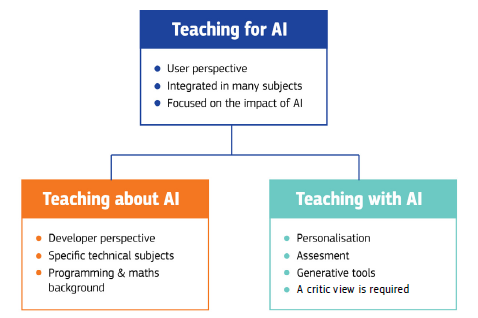
- In terms of curriculum, teaching about AI should be included as specific subjects or courses (or part of them) with a detailed program covering the main AI topics (perception, actuation, reasoning, representation, learning, impact, etc.). The learning outcomes are more technical and specific, so before learning about AI, students should receive background training in maths, programming, and other technical knowledge required to properly understand the AI topics from a developer perspective. Teaching for AI could be organised in a more transversal manner through embedding it in different courses and areas (e.g., language, history, natural sciences, mathematics, arts). The learning material could be organised as small activities within different subjects (not only technical), or as specific subjects where the AI topics are delivered without relying on deep technical aspects (like programming). Learning for AI does not require a specific background in maths or programming.
- In terms of methodology, in teaching about AI, students develop simple AI-based solutions by programming them, while in teaching for AI, they can focus on analysing existing AI-based applications or tools by using them, understanding the way they work and their impact.
- In terms of specialisation, teaching for AI is necessary for all students, independently of their area (humanities, science, engineering, arts). Teaching about AI could be targeted to technical paths, thinking about those students interested in working as “AI engineers”. Hence, teaching for AI is a pre-requisite for educators and learners before moving to teaching about AI.
- Focus first on teaching for AI by means of practical projects and learning scenarios that provide activities for teachers to engage students in activities that improve knowledge, skills, and attitudes towards how AI systems are used in today’s society and focus on everyday application that are driven by AI.
- Take advantage of existing resources for teaching with AI to enhance teaching and learning. It is essential to know how to select tools that align with the curriculum, pedagogical goals, and students’ requirements, while considering the efficacy, ease of use, and privacy issues associated with these tools.
- Apply a developer approach when teaching about AI to train more specialised students in the fundamental areas of real-world AI, like perception, reasoning, representation or learning. They must face different AI challenges through hands-on and programming projects, so they attain the AI basics from a more technical perspective.
- Što se tiče kurikuluma, poučavanje o umjetnoj inteligenciji trebalo bi biti uključeno kao posebni predmeti ili tečajevi (ili njihovi dijelovi) s detaljnim programom koji pokriva glavne teme umjetne inteligencije (percepcija, aktivacija, rezoniranje, predstavljanje, učenje, utjecaj itd.). Ishodi učenja su više tehnički i specifični, tako da bi prije učenja o umjetnoj inteligenciji, učenici trebali dobiti temeljno obrazovanje iz matematike, programiranja i drugog tehničkog znanja potrebnog za pravilno razumijevanje tema umjetne inteligencije iz perspektive programera. Poučavanje za umjetnu inteligenciju moglo bi se organizirati na transverzalniji način ugradnjom u različite tečajeve i područja (npr. jezik, povijest, prirodne znanosti, matematika, umjetnost). Materijal za učenje može se organizirati kao male aktivnosti unutar različitih predmeta (ne samo tehničkih) ili kao specifični predmeti gdje se teme umjetne inteligencije predaju bez ulaženja u dublje tehničke aspekte (poput programiranja). Učenje za UI ne zahtijeva posebno znanje iz matematike ili programiranja.
- Što se tiče metodologije, u poučavanju o umjetnoj inteligenciji učenici razvijaju jednostavna rješenja temeljena na umjetnoj inteligenciji programirajući ih, dok se u poučavanju za umjetnu inteligenciju mogu usredotočiti na analizu postojećih aplikacija ili alata temeljenih na umjetnoj inteligenciji, koristeći ih, razumijevati načine na koji rade i njihov utjecaj.
- Što se tiče specijalizacije, poučavanje za umjetnu inteligenciju potrebno je svim učenicima, neovisno o njihovom području (humanističke znanosti, prirodne znanost, inženjerstvo, umjetnost). Poučavanje o umjetnoj inteligenciji moglo bi se uključiti u tehničke smjerove, imajući na umu učenike zainteresirane da postanu "inženjeri umjetne inteligencije". Stoga je poučavanje o umjetnoj inteligenciji preduvjet za učitelje i učenike prije nego što prijeđu na poučavanje o UI.
- Najprije se usredotočite na poučavanje za umjetnu inteligenciju kroz praktične projekte i scenarije poučavanja koji predlažu aktivnosti za uključivanje učenika u aktivnosti koje poboljšavaju znanje, vještine i stavove o tome kako se sustavi umjetne inteligencije koriste u današnjem društvu i usredotočuju se na svakodnevne primjere primjene umjetne inteligencije.
- Iskoristite postojeće sadržaje za poučavanje s UI kako biste poboljšali poučavanje i učenje. Ključno je znati kako odabrati alate koji su u skladu s kurikulumom, pedagoškim ciljevima i mogućnostima učenika, uzimajući u obzir učinkovitost, jednostavnost korištenja i zaštitu privatnosti tih alata.
- Primijenite razvojni pristup pri poučavanju o umjetnoj inteligenciji kako biste obrazovali specijalizirane učenike u temeljnim područjima umjetne inteligencije u stvarnom svijetu, poput percepcije, rezoniranja, predstavljanja ili učenja. Učenici bi se trebali suočiti s različitim izazovima umjetne inteligencije kroz praktične i programerske projekte, tako da svladaju osnove umjetne inteligencije iz tehničke perspektive.